
A Becoming
For Me, It Begins Long Before the First Brushstroke

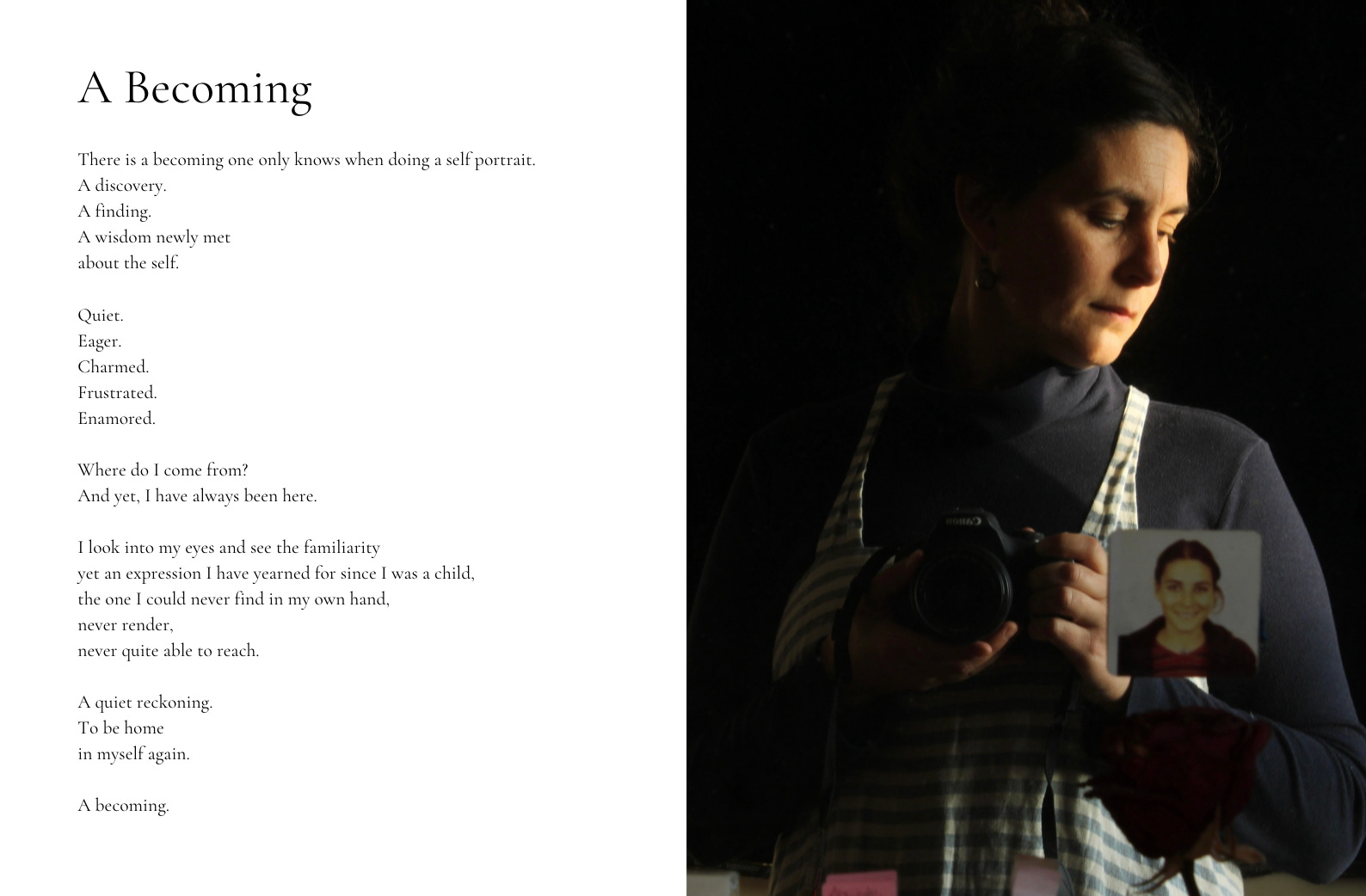
What is it to make a self portrait?
For some, the answer is practical. A model is not always available. The self becomes the most immediate subject at hand, ever present, ever waiting.
But there is another reason. One less spoken about.
To paint another person is an act of intimacy. The long hours of looking. The slow accumulation of knowing, how light finds a particular cheekbone, the way a mouth holds its silence. It is quiet. Something passes between painter and subject in that time.
A trust.
A tenderness.
A connection.
And yet there is a boundary that observation alone cannot cross.
Your own face offers no such distance. It looks back. It knows everything you have not yet allowed yourself to see. It has been waiting, perhaps longer than you realized. What it holds is something only you can know from within.
I have spent years in devoted study of the human figure. Drawing. Sculpture. The body as architecture,
as weight,
as life.
These lessons do not end. But portraiture, I confess, I ran from it long ago. Something in its closeness unsettled me. The requirement not just to observe, but to be seen.


And yet, artists have always turned to themselves.
Rembrandt did it across a lifetime. From a confident young painter to weathered old man, returning to his own face again and again. Not out of vanity, but out of witness. Each self portrait a quiet reckoning with time. A man documenting his own passage through it, without flinching, without flattery.


Frida Kahlo turned the self portrait into mythology. Her face became a landscape of pain, identity, and defiance, dressed in cultural inheritance, in flowers and thorns, in symbols that declared who she was and where she came from. For Kahlo, it was not discovery so much as declaration. A refusal to be unseen.


Helene Schjerfbeck kept returning, but toward something different. Over decades she stripped her self portraits back until the face became almost spectral, technique dissolved, surface dissolved, what remained more interior than likeness. She was not constructing. She was excavating.


Egon Schiele looked at himself raw, exposed, uncomfortable in a way that still unsettles. His self portraits feel less like looking in a mirror and more like opening a wound. Not discovery, yet … something closer to compulsion.


Four artists. Four entirely different relationships to the same act.
Which asks the question: is the self portrait always an act of discovery? Perhaps not. Perhaps it is sometimes witness. Sometimes myth. Sometimes excavation. Sometimes compulsion.
And sometimes, all of these at once.


For me, it begins long before the first brushstroke.
The materials.
I make my own paints for my work. Ground by hand. Mixed with intention. It is a conversation with time
my lineage,
my voice,
my narrative made physical.
Touch is my first language.
And perhaps that is why this is the truest way I know to make a self portrait. Not only to look, but to hold.
To cook, to calcify, transform over the fire.
To wash.
To grind.
To feel the earth become pigment. The paint carries both its own ancient history and the particular pressure of my hands.
It becomes its own self portrait, one that tells mine.
Something happens in the making that cannot be planned or said. The slowness reveals something. The repetition. The attention the materials demand
not conceptual,
not symbolic,
but physical,
present, and bodily.
The self portrait does not begin in the mirror. It begins here. In what I choose to carry into the work. In what the earth offers and what the hands receive.
I am earth. The Virgin and the Goddess. The sacred and the elemental. The one made from the same substance as the painting itself.
I am becoming.


